Thursday, 16 April 2015

#revision - ITALIAN NEO-AVANTGARDE

Whilst I have covered the neo-avant garde in a previous post, I would like to think more specifically about the Italian neo-avant garde artists, namely Lucio Fontana, Alberto Burri and Piero Manzoni. Of course Peter Burger's Theory of the Avant-Garde comments on the failings of the neo-avant gardes, stating that any revolutionary tendencies are replaced with repetition and institutionalisation, I would like to this about the Italian artists as reacting to their post-war status in Italy. Whilst they all do in some ways deal with the idea of the 'monochrome', it is less so in a repetitive and reductive way as seen the American East coast artists, and more so in a culturally significant way.

For artists like Burri and Fontana the dialectic relationship of damage and repair is evident in their works, and for Jaimey Hamilton, this can be reminiscent of the damage caused by the war, particularly in the case of Burri. Hid stitched burlap sacks are overlaying red painting or globulous plastic surfaces which have an uncanny resemblance to the injured body. Whilst Hamilton appreciates that Burri himself has never admitted to any of these suggestions that have been made about his work, he employs a Freudian theory of repetition through repression to enforce his argument, stating that the dynamic of damage and notions of war are undeniable. Instead of simply rethinking the monochromatic and reductive tropes of the historic avant-garde as Burger would suggest, Burri is instead creating work out of a culturally situation and time.

This type of damage is reflected in the work of Fontana too, however with less conviction and explicitness than in Burri. Fontana's Spatial Concepts from the 1950's deal with the gestural movements, from stabbing to slicing, which play with the stability of the surface. Greenberg believes that the surface of the work in an important part of modernist painting, but Fontana almost violates this by destroying this plane. Fontana believed that the something new had to be created to replace the traditions of painting and sculpture, and to do this he creates through his destruction in an ironically similar way to the nihilism and utopian dialectic that runs deep in the historic avant-garde.

Alongside the dynamic of damage, there is also a fascination with the commodity and it's new found place in society, especially within the art market. For Manzoni, this was a key theme that ran through his work. As noted before, he had his Acromes, which dealt with the reduction of the last pictorial element that runs through most monochromes, colour, and deals with repetitions and differences within them. Some of his other work was more heavily based on consumer culture, and was acted out in a performative way. In a 70 minute performance participation piece, Manzoni hard boiled eggs and signed the shell with his thumb. These eggs were then given out to viewers and eaten, literally consuming his art works and the 'aura' of the artist. In the crude Artist's Shit, tins of what is meant to be Manzoni's faeces is placed in tins and sold for the weight of gold at the time. The packaging was printed in different languages so that it was a true global mass consumed commodity, and it is clear that these gestural and performative works question the ideals and values of the art world.

The performance aspect of all three of these artists work is just one way that they are united. Black and white photographs by Ugo Mulas heighten the drama and narrate the story of creation that these works go through.

Images to use:


#revision - NEO-REALIST ITALIAN FILM

As part of my Italian Avant-garde course this year, we did a week on post-war Italian neo-realist film, which opened me up to a whole new medium of art making that can be as symbolically rich as any painting or sculpture. With a focus on Rome, Open City from 1945 by Roberto Rossellini, Bicycle Theives by Vitorria Di Sica from 1948 and L'eclisse from 1962 by Michaelangelo Antonio, I will consider the changing notions of the city and its periphery, as well as the rhetoric potential of sites and buildings within film.

The EUR on the outskirts of Rome was built as a fascist cultural marker for the 20 years of power that Mussolini had achieved, as well as marking the hopeful future of fascism within Italy. Placed towards the Mediterranean Basin that Mussolini hoped to one day be in control of, the EUR would have been a powerful and symbolic place had it been completed prior to WWII. Unfortunately, the neo-classical building was left abandoned, and after the collapse of the Italian Fascist regime in 1943, the building had a ghostly and empty presence, and the EUR came to symbolise the damaging past. It is this symbolism that John Rhodes uses when speaking about Rossellini's film Rome, Open City, which is a work highly critical of fascism. Rhodes highlights how the pivotal and devastating scene of leading lady Pina's death is closely followed by a scoping view of the desolate EUR landscape, with Rossellini believing that buildings and places hold strong rhetoric values. Whilst this may be the case, and made for highly emotive and charged scenes in the film, Rhodes argues that places are static and values are place upon them from the outside, a case that is acutely clear with the EUR.

Rome, Open City depicts the EUR as a ghostly reminder of a fascist past, however if we compare this to its interpretation in Antonio's L'eclisse, shot on location less than twenty years later, the change is significant. After the economic miracle in Italy, the EUR became a sight for suburban development, where many middle class families moved to live. Instead of holding onto the ghosts of its past, the EUR became a centre of capitalist consumer culture, or as Antonio calls it, 'the world the bourgeoisie'. At the end of L'eclisse, fragmented shots of urban life flick past one another to a silent score of music, each shot dragging, emphasising the mundanity of life but adding an anxious undertone to the film. The anxiousness is furthered with the onset of the nuclear bomb and fear of losing the economic security that they have. Antonio uses these film medium techniques to create a tense environment and the underlying issues and anxieties that lie beneath the pleasant bourgeoisie exterior.

Both of these films have a dominant focus on the EUR and its changing symbolism, however they also actively focus on the periphery of the city. After being war torn, Rome was under stress to deal with the poverty that the war bought, and inner-city housing projects were developed under the Marshall Plan. In Bicycle Thieves from 1948, the poverty of this region is highlighted, showing ramshackle and unfinished buildings. There are critical undertones towards fascism and war and the devastation that it bought.

Film can be a powerful way of creating relationships with politics or revolutionary change, especially when loaded with symbolism. The periphery of Rome was a changing place post-war, and as the final scene of Rome, Open City suggests, in which we see the cast walking towards the city and St Peter's cathedral, the city and religion seem to be the salvaging hopes.

Images to use:


#revision - NEOCONCRETISM

Neo-conrete art in Brazil during the 1950's and 60's was reassurance of the fact that the re-shaping of art was not just a European and American movement, but also a global one. Concrete art was influences by the constructivists of Russia, and neo-concrete was a strain of the same movement that focused on putting more colour and sensuality into the movement. I am going to focus on the relationship that neo-concretist's formed with the body through their art, particularly looking at the work of Lygia Clark and Helio Oticica.

The manifesto for neo-concretism featured the names of influential artists such as Mondrian and Malevich and their focus on reduction and geometry, and the artists in Brazil used these as influences in their movement, but aimed to do so in a way that was sensual and engaged with the body, but still had purity in non-representation forms. Both Clark and Oticica started their neo-concrete careers creating geometric and monochromic forms, with Clark's being on a match box scale and Oticica's being larger. Both could be moved and engaged with and both honoured the constructivist ideals of geometric purity. Out of these objects, Clark and Oticica developed individual styles that involved viewer participation.

Clark turned to psychotherapy in 1975 and was interested in the mind, and her works speaks volumes for this interest. Her 'creatures', which were geometric sculptures that could be moved in a way that was similar to an organic being, necessitated viewers as being vital for their existence. Guy Brett writes of these objects as only being meaningful when they are in participation with a viewer, and that each meaning and understanding of the object is assigned through a personal and intimate experience with the object. This type of 'intimacy' is also seen in Air and Stone from 1966, where cheap materials such as a plastic bag filled with air and a stone are utilised, and the bag is gently pushed and let go of so that the stone rises and falls, synonymous with the breathing pattern of a human and used in a therapeutic way. Clark's deliberate use of cheap and attainable materials come out of her desire to create work that 'anyone with my [Clark's] roots can make'. For her, the constructivist tendencies of creating a social art have not died.

Oticica also created works that demand a viewers engagement to be validated and understood, and did so by creating his Paragoles which were colourful creations made of material that were created to be worn. Ideally they were to be worn when dancing to the samba, creating a sensual explosion of colour and unifying a group of people.

Images to use:


#revision - PROCESS ART

Today I am going to look at 'Process Art', focusing on the works of Eva Hesse and materials that keep evolving even after their creation, and what this means for their display and longevity.

'Process Art' is a type of art that focuses on the process of making and evidence of making, with the end product seemingly not as important. It seems like a strain of conceptual art, in which the end product means less than the idea, but becomes a much more physical rather than metaphysical way of creation, where the appearance of the end product is determined by the process instead of the idea, making the object a pivotal part of the work. The process of making is not hidden away, and even becomes the subject of the work. As Greenberg says, the role of modernism in art means that art can be about itself, with no defined representational subject. 

Eva Hesse is renowned for her work with latex, using it for it's experimental properties, it's positioning in the realm between painting and sculpture and it's bodily properties. Using latex that can be painting in sheets, Hesse created Augment in 1968, layers of latex partially stacked over one another and placed on the floor. These rough edged layers do not shy away from their process of creation, but what is most important about latex is the ongoing process it goes through in it's life. Starting life as a pale, flexible and rubbery surface reminiscent of flesh, through humidity and oxidisation the latex begins to harden, yellow and eventually crack away, slowly but surely disappearing. This ongoing process can be seen as being a trope in Hesse's work, who justifies the change by saying 'art doesn't last. Life doesn't last. It doesn't matter'. Whilst this may be the case for the artist, it has been a substantial problem for museums and galleries who show Hesse's work. 

At the 2013 Venice Biennial, there was a re-staging of the 1969 show When Attitudes Become Form, curated at the time by German Celant. Augment was one of the works to feature in the original show, but due to the process of change that the work had undertaken over the last 30 years, the work was damaged and cracked and the top layers, and the sheets had to be changed around and moved in order to re-exhibit the work. Thankfully the lower layers had little oxidisation deterioration and could be utilised. It is this type of  'process' that vex's museums today, but captures the artists intent perfectly. 

Process art can also link directly the post-studio art that was spoken about in the last post. Keith Sonnier's Red Flocked Wall also utilises latex, and is created by painting it directly onto the wall and the peeling the lower part off so that the latex covering hangs. The process of making is evident in this work, and as it is not made in the studio it is original to each gallery space it is presented in. For Mel Bochner in 1 language is not opaque, the same process occurs but this time with paint, each time the drips are in different places and the process of making is transparent. 

Images to use: 


Wednesday, 15 April 2015

#revision - POST STUDIO AND CONCEPTUAL ART


Conceptual and post-studio art are terms that can fit a wide range of art types after the 1960's, including land art, performance or more classic mediums such as painting and sculpture. However, it is contested what is meant by the 'post-studio', as the notions of what a studio actually is have come into question. In his influential writing on the studio, Buren posits that the studio is the place where the work is created, and once it leaves this place it loses its aura and context. Buren creates the majority of his art on site so that this aura is not lost, and the work is made to belong where it is situated. But does a studio necessarily mean a room or building in which things are hand-crafted? The traditional notions of the studio are where the solitary artists creates masterpieces in private, and photographs and paintings of the studio have confirmed this mythical identity. The idea of a studio is changing now - if we look at a photograph of Duchamp's 'studio', we see a collection of readymades assorted in an orderly exhibition style manner. What kind of studio produces a readymade? These objects have already existed before entering the 'studio' - we are faced with a non-traditional portrayal of the studio that challenges our preconceived ideas about creation. Maybe the studio has now evolved to a point where instead of a physical place, a mental place can be seen as the origin of the art work. In conceptual art, it is usually the idea that drives the work as opposed to the object itself, and in this changing notion of what constitutes the 'art', what constitutes the 'studio' is also questions.

'The idea becomes the machine that makes the art' - Sol Le Witt summarises that ideas in conceptual art become the important factor that define what makes a certain object or image 'art'. In his writings on contemporary art, Le Witt states that often the object in incidental to the idea, but it is not the agenda of the artist to explain in any depth the idea behind the work. Here, we are left with a confusing made of viewing, where the object is not the work but the idea is not clear. This is the basis for much conceptual work of the time. On Kuwara's Date Paintings seem relatively mundane and repetitive from the outside, with their monochrome backgrounds and their block lettering, and this is partially down to their display as well as the artists anonymity. When these paintings are displayed it is usually hung on a wall without their sub-titles that Kuwara has assigned them, or the newspaper page that they come boxed with, which aligns itself with Buren's theory that paintings lose their aura when in a gallery, as a gallery space does not personalise itself to a work. When the sub-titles and the newspaper are displayed alongside the work, we see a whole different angle - the titles are morbid and consciously aware of the war and death that happens in the world, especially the aggressive happenings in Asia and Vietnam during the 1960's. What is intended from these titles is little known, as the artists own privacy leaves little writings about the topic. Whether it is a comment on the numbing nature of the media on violence, or the process of time and forgetting is unknown.

Whilst Kuwara had a studio, many of his works were done when he was away, and therefore created outside of the studio, fuelled by the idea as Le Witt states. For some artists, including Buren, work outside of the studio is the most valid, as it is created for the space that it lives in. Artists like Robert Smithson and his Sprial Jetty or Mel Bochner and his 1 Language is not transparent create work that lives in the place it is made, and can be recreated if it needs to moved, which is particularly true of Bochner. With his piece, there is a no set 'orginal' piece, which further subverts our notions of what art is meant to be, and reduces that value that the market can put on it.

Images to use:


#revision - NEOAVANTGARDE/MONOCROME


Using Peter Burger's and Benjamin Buchloh's opposing ideas about the neo-avant garde, I will explore why the monochrome has reappeared as an artistic practice and the various ways that the monochrome has been utilised by artists.

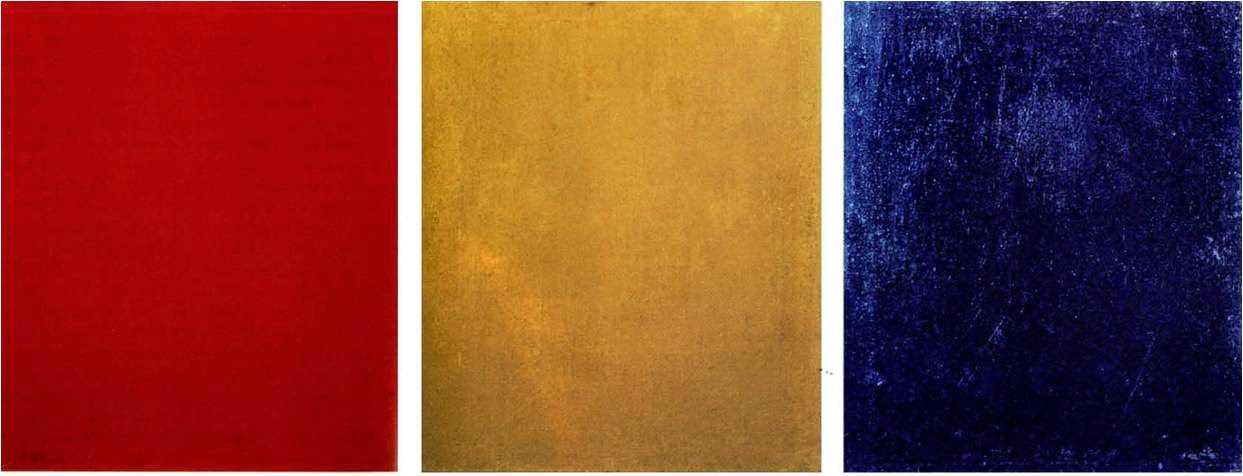
Peter Burger's Theory of the Avant-Garde dismisses the neo-avant-garde has being merely a repetitive form of the historic avant-garde that is void of the original, revolutionary tendencies of the earlier movement. Due to the failings of the historic avant-garde, Burger sees no possible way that by repeating their actions anything meaningful is bought around, and the artworks merely become institutionalised. We need only look at the works of Malevich and Rodchenko that occurred in the last post to see that the monochrome was a break from traditional artistic values and art practice in general. For Rodchenko in his Pure Colours of 1921, all preconceived artistic ideals were removed from the colours - no longer were these representational or emotive tools, they were simply used for their materiality on the canvas. These notions of material colour are reminisced in the work of Robert Rauschenberg, particularly his Black Paintings from 1951, where the texture and reflectivity of the paint and the materials placed under the paint were pivotal to the work, and not any of the emotive associations that are normally ingrained in colour. 'Meaning belongs to people' - this quote from Rauschenberg highlights his desire to distance himself from emotion, a particularly difficult task in a time when artists like Jackon Pollock and Mark Rothko are been revered for their emotional abstract works.

Buchloh enhances Rauschenberg's idea that instead of meaning coming from the inside of the work, it is put on the work from the outside. This interpretation of the neo-avant-garde goes against the theory of Burger, where he believes the artists are trying to assimilate the intentions of the historic avant-garde. Buchloh believes that the meanings put onto monochromes occur from the outside, and uses Yves Klein as his key example. In the spectacle that is Klein, his monochromes are sold for varying prices depending on how much importance is put on them from the outside - there are no obvious distinctions between the canvases, all the paint is rolled on to produce flat even planes and they are exhibited together, yet they sell for different prices. In creating a spectacle, the commodity value of the works goes up, and the value of these work is decided by others. 

This type of monocromy was also occurring in Italy at the time, with Piero Manzoni's Achromes being deliberately void of representation and focusing instead on the materiality of the work. 'To suggest, to express, to represent: these are not problems today' - Manzoni's thoughts seem to echo those of Rauschenberg and Buchloh, where art has long been emotive and representation. By using works of varying textures such as polystyrene, wool, fur and feathers but keeping the colour white, Manzoni is playing with materiality instead of emotive associations, as does Rauschenberg in his White Paintings - they are seen as purely reductive. Reduction was always a trope of the historic avant-garde, who used it as a shock factor. In its more modern use, we can see how Burger's theory of institutionalisation has played itself out, regardless of the meaning of the works themselves.


Images to use:


Tuesday, 14 April 2015

#revision - ABSTRACTION


For Clement Greenberg, modernism is born out of self-criticality. This self-criticality within painting picked up that since painting began, the flat surface of a painting has been seen as a pivotal part of what makes a painting a painting and which sets it apart from all the other arts. On top of this flat plane, a three dimensional image has been created, which in some ways negates the fact that it is on a flat surface, as nothing eludes to this within the image. 'Flatness alone was unique and exclusive to pictorial art'; Modernism, for Greenberg, focuses on the emphasising this plane and making use of it, doing away with figurative representation, as three-dimensionality is something shared with sculpture, and becoming autonomous through the individual use of a flat plane.

Artists like Piet Mondrian and Malevich have used abstraction as means of emphasising the surface of the work. In Russia, Malevich created his famous Black Square as a reduction of all representation and even that of colour. When representational art had become so tied up in bourgeoisie values, it was important if Russia was to succeed with a new regime to distance themselves artistically with this past. Alexander Rodchenko created the Last Painting in 1921, three monochrome panels that consisted of the primary colours red, yellow and blue. This was seen to be the 'death of painting', as it showed painting in its purest forms - the three primary colours, which make all colours, and the flatness of the three canvases. From this moment onwards, Rodchenko had a preoccupation with photography, especially after the rise of the Bolsheviks in 1917 deemed abstraction and suprematism to be disengaged with the everyday reality.

Mondrian emphasises the plane in a slightly different way. Whilst the monochromes in Russia are void of all representation, there are still some simple, pure elements of that in Mondrian's grids. Following a repetitive grid method that he used for 25 years, Mondrian created many works that follow the same repetitive technique but are infinitely different in their representation. The act of repetition, or 'systematic' art, uses repetition not to show similarities but to show differences. Mondrian's art shows that not all artistic license is lost when figurative painting is removed. 

Two modern artists who have carried on the trope of abstraction are Barnett Newmann and Ellsworth Kelly. Both of these artists use monochromes to emphasis the flatness of the surface, and both loosely utilise grid formations. Newmann's One from 1948 is a monochrome (made in a series of 5, furthering the 'systematic' process of abstract art) with a single vertical line down the middle, showing it is conscious of the limits of the surface and the edges of the plane, whereas Kelly's Red/White from 1953 uses the grid in a more explicit way, with the whole canvas being in a grid formation. This formation is one of the most effective ways to play with the Freudian idea of chance, which many artists during this time are occupied with. 

Images to use: